Public · Procedural strategy
Defend
A physics-driven strategy game where finite energy connects health, construction, defense and economic consequence, making every defensive choice part of the same resource model.
- Niche
- Systemic tower defense / physical strategy
- Core stack
- TypeScript · Babylon.js · Rust/WASM experiments
- Design
- Closed economy · temporary infrastructure · physics
- Status
- Playable historical build + modernization program
The study
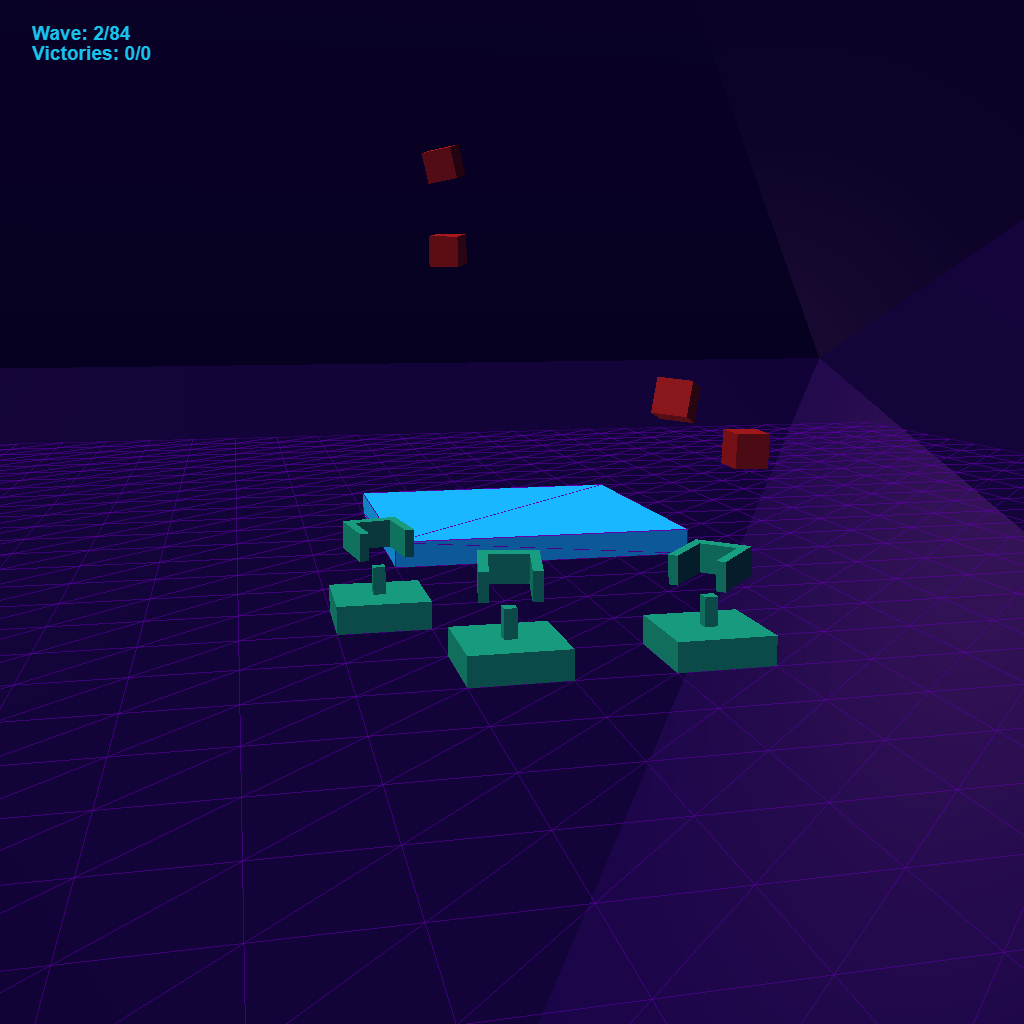
Defend turns tower defense into a physical battlefield that can be shaped, delayed and manipulated.
Mass, momentum, collision, obstruction, knockback, gravity and time are tactical variables. Attackers can be delayed until their finite life expires, redirected, trapped, pushed from the arena or destroyed through direct damage.
System structure
One finite resource connects the game’s major systems.
The protected resource also supplies health, building budget, combat recovery and strategic operating cost.
Finite-lived raiders make delay and route shaping meaningful strategies alongside damage.
Towers create periods of control within a battlefield whose geometry and pressure continue to change.
Campaign progression expresses the player’s changing relationship to the energy economy through mechanics and resource flow.
Product and interaction design
Motion, geometry, sound and visible resource flow explain the world directly.
Continuous physical trade-offs and visible cause and effect let the player infer why an action worked by watching the system respond.
Progression expands defensive capability while the shared finite resource keeps each new option economically meaningful.
Development approach
The historical playable build is a living sketchbook of interactions, providing a concrete reference for study and modernization.
Modernization starts by isolating one behavior—a collision, decay rule, energy exchange, sound response or enemy tactic—and recreating it in a small Storybook or deterministic laboratory. These focused experiments make “what if?” questions inexpensive while the full game remains available as a behavioral reference.
Promising experiments are compared with the historical build and encoded as explicit contracts before they enter the main architecture. The process combines archaeology, prototyping and proof so character, mechanics and implementation can evolve together.