Check the forecast
Look at the day’s weather and the seller’s confidence before spending money. Conditions can make the same plan perform very differently.
Player guide
Every morning gives you a forecast and one simple problem: decide how much lemonade to make, how much to advertise, and what to charge. Then open the stand, watch the day play out, read the results, and adjust tomorrow.
Quick start
You do not need to understand a formula before playing. Read the conditions, make three choices, and use the next report as feedback.
Look at the day’s weather and the seller’s confidence before spending money. Conditions can make the same plan perform very differently.
Decide how many cups to prepare. You pay to make them before you know exactly how many people will buy.
Advertising can bring in more demand, but every sign costs money. Spend only what the day can reasonably earn back.
Higher prices earn more per sale but reduce demand. Lower prices attract more buyers but leave less revenue per cup.
Commit your choices and watch Lemonsville react. Your decisions are locked while the day resolves.
Compare prepared versus sold, revenue versus costs, and the ending balance. Then change tomorrow’s plan based on what actually happened.
Your three choices
The daily game deliberately stays small. Weather and confidence matter, but they are conditions to react to—not extra knobs to manage.
Prepared glasses set your maximum possible sales for the day. If demand is higher than your inventory, you sell out. If demand is lower, the unused production cost is already spent.
Signs increase potential demand, but each sign costs $0.50. Advertising can be powerful, especially when the rest of your plan can support the extra customers.
Price directly trades volume for margin. Raising it reduces potential demand; lowering it can attract more buyers. The best price depends on weather, confidence, inventory, and your available cash.
Starting point: a new stand begins with a $10 operating balance. Each prepared cup costs $1.00. Avoid committing all of your cash at once; you need enough room to recover from a weak day.
Conditions
Weather and confidence can change how much demand your price and advertising produce. Treat them as signals about risk and opportunity.
Better lemonade weather can multiply demand sharply. Poorer weather can make an aggressive inventory or advertising plan expensive.
Confidence reflects recent operating performance. Strong results can improve it; weak results can reduce it. Higher confidence helps potential demand, but it does not guarantee a profitable day.
After closing
The report is your main learning tool. Do not judge a day only by revenue; compare sales with the money you committed to production and promotion.
You may have left sales on the table. Next time, consider preparing more—but only if the added production cost still makes sense for similar conditions.
You probably overproduced for the demand you created. Try less inventory, a lower price, more advertising, or a combination—but change deliberately so you can tell what helped.
Growing the stand
Your operating balance controls the scale of the stand. As it grows, the game raises the maximum number of glasses, signs, and price you can choose. Falling back below a threshold can reduce that capacity again.
Below $100, you can prepare up to 15 glasses, use up to 3 signs, and charge up to $2.99.
At $100 and $500, larger operating ranges unlock. More capacity creates more upside—but also makes expensive mistakes possible.
At $5,000 and above, the largest operating range becomes available. Later finance systems can also add fees, taxes, banking, credit, and interest around the same three daily decisions.
Starter tactics
The fastest way to improve is not to chase a perfect formula. Make controlled changes, watch the report, and learn how each condition changes the result.
Production and advertising are paid before the day resolves. Keep enough balance to survive a bad forecast or a poor experiment.
If you radically change glasses, signs, and price together, the report cannot tell you which change mattered most.
Selling every glass is not automatically optimal, but repeated sell-outs in similar conditions suggest your inventory ceiling is constraining sales.
Unsold glasses mean you paid for capacity the market did not use. Compare leftovers with price, advertising, weather, and confidence before the next day.
A higher price increases revenue per sale while reducing demand. Watch total profit, not just the price tag.
The same setup should not be repeated automatically every day. Weather and confidence are there to make yesterday’s answer uncertain today.
Behind the game
You never need the equation to play well, but it explains why signs, confidence, price, and weather can combine into surprisingly different days.
The result is rounded to a whole number of potential customers, then actual sales are capped by the number of glasses you prepared. In other words: advertising and confidence push demand upward, price pushes it downward, weather can amplify everything, and inventory still sets the final ceiling.
A useful curiosity: advertising is deliberately nonlinear here. The sign term is signs² / log1p(signs), so signs can become very powerful instead of following a simple diminishing-return curve.
Then and now
The modern game keeps the original spirit—three decisions, weather, uncertainty, and immediate consequences—but it does not copy the Apple II economics exactly.
| System | Apple II version | This Lemonade revival |
|---|---|---|
| Price | Used a 10-cent reference price and a much steeper inverse-square penalty above it. | Price enters continuously as an inverse term. There is no special breakpoint where the rules suddenly change. |
| Advertising | Used an exponential response with diminishing returns. | Uses the unusual signs² / log1p(signs) term, so advertising behaves very differently and can scale aggressively. |
| Demand base | Started from a baseline demand of 30 before price, signs, weather, and events changed it. | Builds potential demand from advertising plus confidence, divided by price, then multiplied by weather. |
| Confidence | Not the same persistent operating-confidence system used here. | Recent business performance changes confidence, and a seeded daily confidence roll feeds demand. |
| Weather | Weather and special events changed demand through the original BASIC rules. | Uses four weather strengths—1×, 2×, 5×, and 10×—with the opening day starting at the strongest state. |
| Randomness | Used the period program's random draws. | Uses seeded randomness, so the same starting seed and decisions can reproduce a run. |
| Presentation | Text, simple color graphics, sound cues, and keyboard interaction on the Apple II. | A live 3D Lemonsville, visible customers and signs, accessible reports, charts, progression, and later finance systems around the same three daily choices. |
Where the game came from
Lemonade keeps the quick decision-and-feedback spirit of the educational games that came before it. The history is here for players who want to know why the game is deliberately simple to learn and difficult to optimize.
Bob Jamison created the original Lemonade Stand program at the Minnesota Educational Computing Consortium for time-shared computer systems.
Charlie Kellner adapted the program for the Apple II, bringing the business exercise into the early personal-computer classroom.
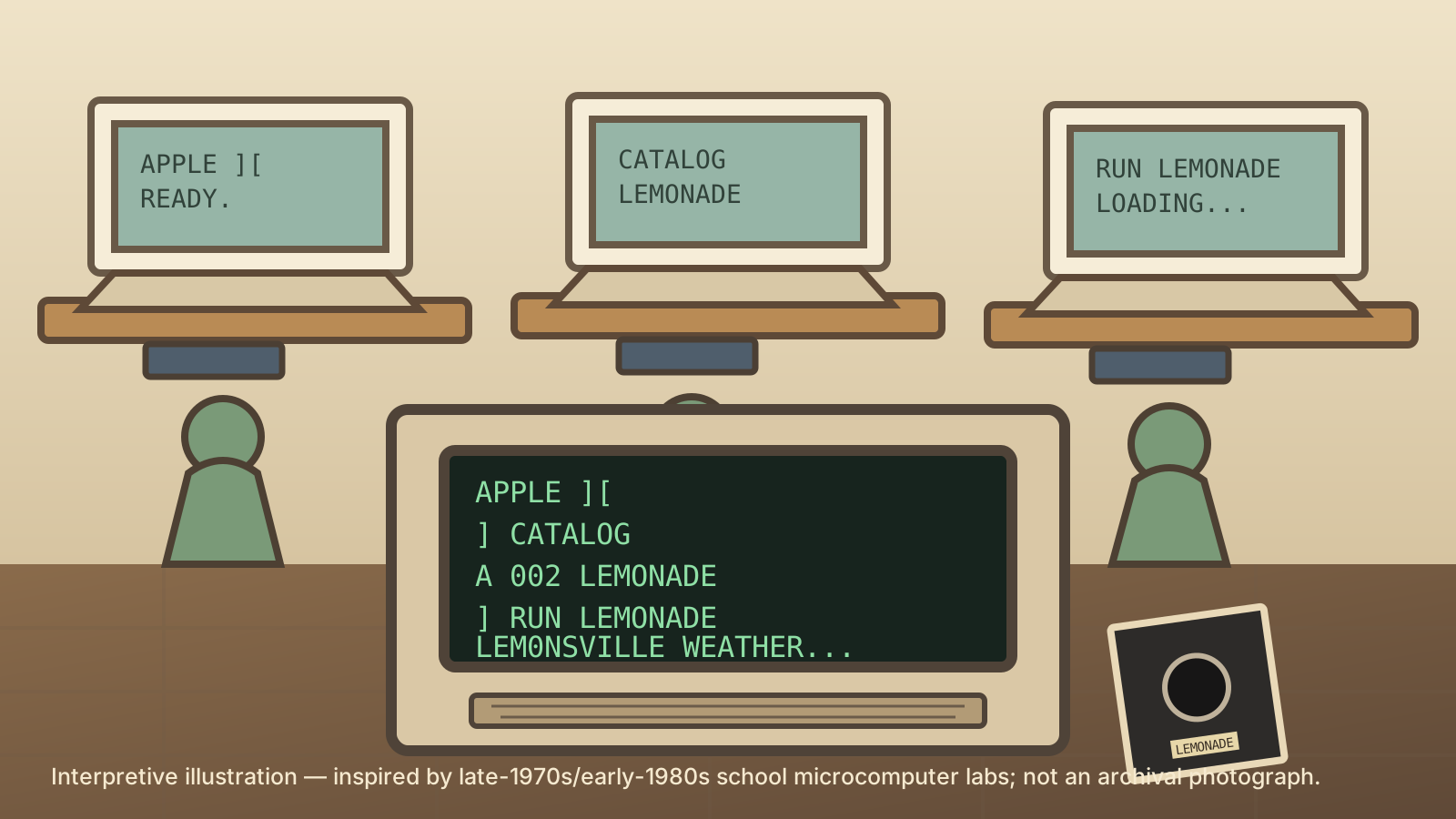
Apple II computers became familiar school lab machines, where students learned by trying software, comparing results, and taking turns around shared screens.
The modern revival keeps the small daily decision surface while making the neighborhood, customers, weather, reports, and progression visible around it.
Historical references
These links support the historical section. They are optional reading and are not required to understand or play Lemonade.